

Thirty years ago, conservation efforts in Hawaiʻi were growing in response to increasing threats to native ecosystems, endangered species and cultural heritage. While many of today’s large-scale restoration efforts were in their seminal stages, key movements and policies were already shaping the future of conservation in the islands. Among them was the Pacific Internship Programs for Exploring Science (PIPES) that started in Micronesia and Samoa led by Sharon Ziegler-Chong, a then-Hawai‘i extension agent with the Sea Grant at UH Mānoa.
“The genesis of PIPES was simple,” said Ziegler-Chong, now the Associate Director of Land and Ocean Conservation with the University of Hawai‘i-Mānoa. “Colleagues and I were working with collaborators in the US affiliated Pacific Islands through the Pacific Island Network, an interagency program led out of Sea Grant, and they told us that students were either leaving their island homes for Hawai‘i and Guam or elsewhere, and not returning, or coming back with degrees unconnected to the needs at home.”
Expanding Opportunities for Future Conservation Leaders
In 1994, the U.S. Department of the Interior’s Office of Insular Affairs provided funding for six summer interns at UH Hilo from across the Pacific to return to their native island nations and to work on various projects involving natural resources agencies and organizations. The program’s success with interns, organizations and communities caught the attention of Ziegler-Chong’s NOAA colleague, who proposed expanding it to Hawai‘i.
By 1997, UH Hilo hosted eight interns collaborating with conservation organizations across the Hawaiian Islands. As the program expanded, the Pacific and Hawai‘i cohorts merged in 2003, forming what is now known as PIPES.
“PIPES has consistently aimed to cultivate Hawai‘i’s future generation of conservation leaders,” said Nalu O’Connor, PIPES program leader. “During our 10-week summer internship, for example, undergraduates learn about ethical research, cultural sensitivity, reciprocity, land management and responsibility in aloha ʻāina.”
The foundation of PIPES is based on its Mo‘o ʻĀina Pathway Programs, which provides four distinct pillars: Naʻau (Ancestral Pathway), ʻĀina (Ecological Pathway), Kaiāulu (Community Pathway) and Kaʻao (Research Pathway). Each one of the pathways offers opportunities for interns, mentors and community members to focus on best practices toward building and maintaining healthy and abundant ecosystems.
“Internships include hands-on work experience, one-on-one mentorship, mentor and intern development workshops, cohort learning spaces and networking opportunities,” O’Connor explained. “The program’s framework, which includes the intersection of place, people and practice, is what helps our organization define this concept and relationship of aloha ʻāina.”
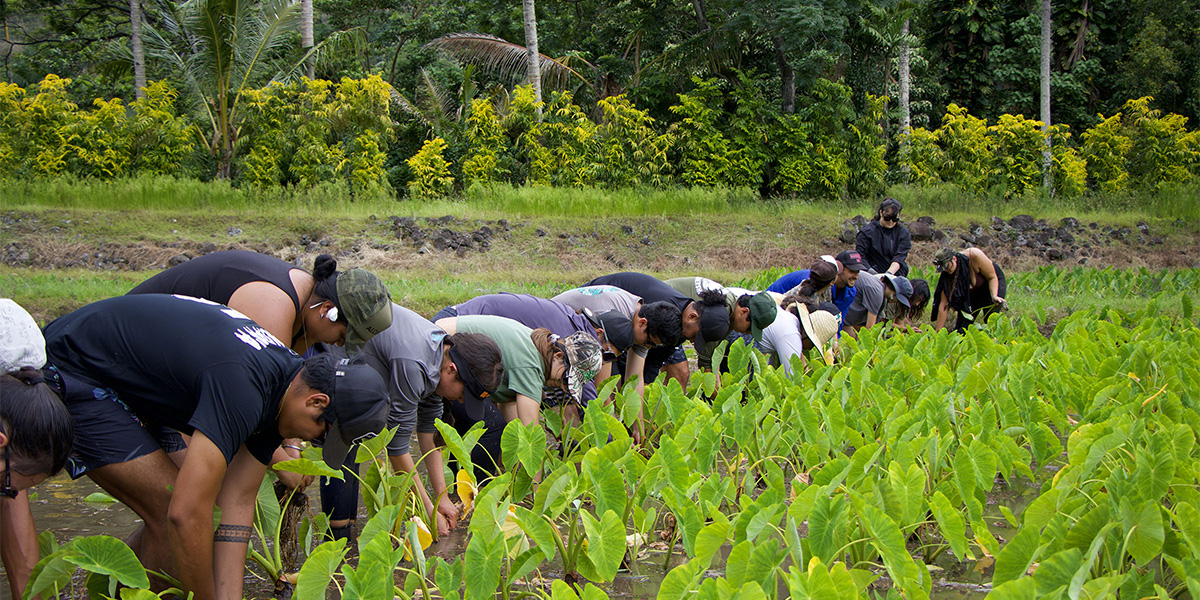 PIPES interns get hands-on in a loʻi kalo, learning traditional farming practices that deepen their connection to ʻāina and community-based conservation.
Strengthening Local Conservation Networks
The program also offers an expanded internship model this year, with five former interns returning to participate in a yearlong internship, working directly with different organizations in Hawaiʻi. OʻConnor highlighted that this model – centered on experiential and cohort learning – plays a pivotal role in encouraging future leaders who not only understand conservation but are deeply connected to the communities they serve.
Before PIPES and its sister collaborations, conservation efforts often operated separately from local communities. When establishing the Hawai‘i program, agency leaders shared a common challenge: they struggled to find local applicants. PIPES helped bridge this gap by partnering with organizations to recruit and fund interns, providing not just a summer experience but a connected cohort committed to island resource stewardship.
“PIPES has always been a cohort model – creating and linking interns into a network of their fellow summer interns and with the alumni before them,” said Ziegler-Chong. “It has always had a high percentage of people who continue into the conservation sector, carrying those networks with them into their studies and careers.”
Questions? / More Information
If you would like to learn how you can support UH students and programs like this, please contact us at 808-956-8700 or send us a message.