
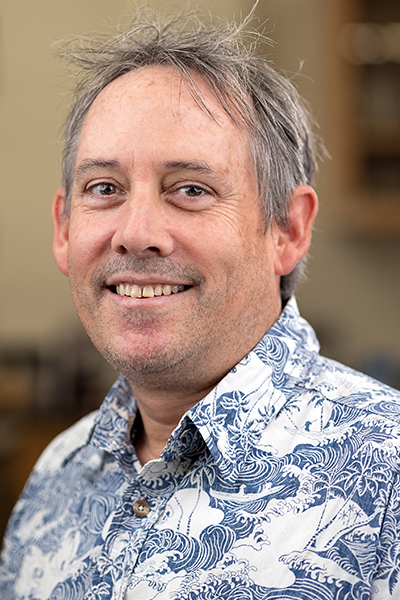
 Dr. Craig Nelson is leading research on coral reef resilience in the wake of the Lahaina wildfires, focusing on how pollutants affect coral microbiomes.
How are the coral microbiomes different today compared to when you first started monitoring them after the fires? Have there been any surprises?
This is a good question, but because we were not actively surveying and documenting coral microbiomes before the fires it is important to provide some context for the project.
Maui has a long history of impacts of land use on the reefs. In particular, the Maui community has long been concerned about how runoff impacts reefs along West Maui and South Maui. The island has a strong history of activism among community members investigating water quality issues ranging from sediment runoff to wastewater pollution. Land use changes are extensive: much of the agriculture on Maui has ended, often leaving the land fallow, and water diversions along with contentious wastewater management programs have contributed to a host of complex changes that have the potential to impact reefs.
Our original intent, before the fires, was to contribute to these efforts by incorporating an understanding of the microbial symbioses of the corals into this context. More specifically, we wanted to understand how corals in areas with sporadic sediment runoff, or associated with wastewater inputs, might exhibit differences in their microbiology. Those differences are hard to predict, but we hypothesized we might see evidence of chronic shifts in the composition of the microbiome associated with areas experiencing documented sediment or wastewater inputs. We also sought to sample around acute impacts to see if runoff events might alter the coral symbioses in predictable ways that could help us understand if they were stressed.
The fires changed how we approached the project. Without “pre-fire” context, we instead sampled to optimize our potential to understand how the fires affected the coral microbiomes. One of our main concerns was that the material from the fire would not impact the reefs immediately after the fires, but would instead cause issues when it was all “washed in” after the first rains doused the burned town of Lahaina. While it rains consistently up mauka and rivers carry sediments into the reefs, rain on the coastline is much rarer and harder to predict. We predicted that one of the strongest potential impacts of the fire would be during the first coastal rainfall, and so we set up “rapid response” monitoring programs that would allow us to sample the water and corals immediately after that “first flush.” This approach was coupled with quarterly surveys both to provide context to detect changes and to monitor for more long-term chronic impacts.
We sampled hundreds of corals four times over a one-year period after the fire, and spread those samples across five sites: two that were more than 10km distant from the fires (one north and one south), and three that were arrayed along the burned coastline. Alongside the sampling of the corals, we had a large team of students measuring chemical and microbial properties of the water. The sampling of the corals was led by Justin Berg, a PhD candidate in marine biology whose dissertation is focused on the microbiology of corals in Maui. Justin’s most recent graduate work was at the University of Guam, where he studied sediment runoff effects on coral microbial ecology, so his background is well suited to lead this aspect of the study.
Here is what Justin had to say about his findings:
My project specifically looked at how post-fire runoff affected the microbiome of two widespread coral species on Maui, Porites lobata and Montipora capitata. The interesting thing about these species is that I hypothesized that the corals and their microbiomes react differently to stress. P. lobata is a coral species shown to be tolerant to environmental stressors such as temperature and nutrients, and there is limited evidence that its microbiome is less likely to be influenced by short-term changes in the environment. Meanwhile, M. capitata has shown varying tolerance to heat stress and has a more diverse and variable microbiome that may indicate it is more responsive to environmental changes.
Over the course of the study, we observed unique shifts in the microbiome of each coral species. The Porites microbiome shifted markedly throughout the region in response to the first major runoff event and when the ocean temperatures were highest, which is a reminder that both runoff and a warming climate impact these corals. Importantly, the Porites microbiomes rapidly returned to normal after these high stress events. Montipora microbiomes also shifted after runoff and during the warmer ocean temperature periods, but these changes were more variable, spatially, and shifts in the Montipora microbiomes persisted for a longer time compared to Porites.
We are currently in the process of examining which microbial taxa shifted consistently in response to runoff in both coral species, and checking to see if any changed differently near the burn to evaluate if there were subtle but specific microbiological impacts of runoff from the burned area that don’t immediately jump out of the data. We also need to analyze the changes in the microbiome in the context of the chemical impacts from the fire. This work, led by PhD candidate Sean Swift, has demonstrated extensive heavy metals contamination in the reefs nearest the burned area, and we will be looking for responses from microbial symbionts known to transform or otherwise metabolize heavy metals in the corals. At the end of our one-year study, the coral’s microbiomes closely resembled the initial microbiomes, which were collected prior to post-fire runoff. Ultimately, the microbiomes of both coral species appeared to recover from the stress events, and we don’t see any clear declines in coral extent, coral health or reef ecosystem processes associated with the fires so far.
What are the encouraging and discouraging aspects of the changes?
As indicated above, we are very much encouraged that there were no clear signals in the coral microbiomes that suggested the fire was having a strong local impact on the corals. There are many consistent signals that the fires had only limited impacts to the reef ecosystems, including minimal evidence of declining reef health, minimal evidence of contaminant accumulation in the tissues of fish or limu, and minimal evidence of contaminant accumulation in the water near the fires beyond the heavy metal enrichment immediately adjacent the harbor.
What this project has revealed is just how strongly the corals respond to land uses. Along with previous work we have done in this area documenting accumulation of pharmaceuticals and other organic contaminants in corals near areas with intensive agriculture or wastewater land use practices, we can see from this work that runoff plays a big role in the delicate symbiosis of the corals. We want to understand this better, and one of Justin’s goals is to identify microbial indicators that could tell us when and where corals are negatively impacted by runoff of different types. As with human microbiomes, the individual and regional variability in these complex communities makes identifying these indicators challenging, and we need a lot of patience and context to untangle these nuances.
What could your project do with a lot more funding?
The first would be leveraging our first steps into tracking the microbiomes of these corals into a longer multi-year study to see how they fare for several years into the future. Corals are long-lived and slow-growing organisms, and the fires emphasized something we already knew: long-term observations and steady, patient sampling through time and space are necessary to understand organisms and ecosystems, and without funding we cannot develop a holistic understanding of the microbiology of corals. We know that the hundreds of symbiotic microbes in their tissues are crucial for their ability to stay resilient to the increasing stressors that they face in our changing coastal oceans, but without careful observation we can’t make sense of the patterns.
The second is developing the corals into sentinels of chronic coastal pollution. As I mentioned above, the community on Maui is already aware and actively investigating water quality issues in their reefs, both for impacts to the ecosystem, to the fisheries they subsist on, and for the health of their communities that live and play in the reefs. Our lab group has developed deep expertise in mass spectrometry-based contaminant analysis that we hope to expand to coral tissues to couple with the microbiome analyses. We now understand just how clearly the coral microbes can indicate the effects of runoff events, and we hypothesize that they can tell us more about what is in the water than simple bottle collections offer. As long-lived organisms, corals can accumulate various toxins in their tissues, and we have preliminary insights that they may be able to document areas where we have invisible chronic pollution that has widespread impacts on our reefs. With more funding to expand our studies to contaminants and toxicology, we may be able to let the reefs tell us where we are going wrong with our land management practices.